.png)
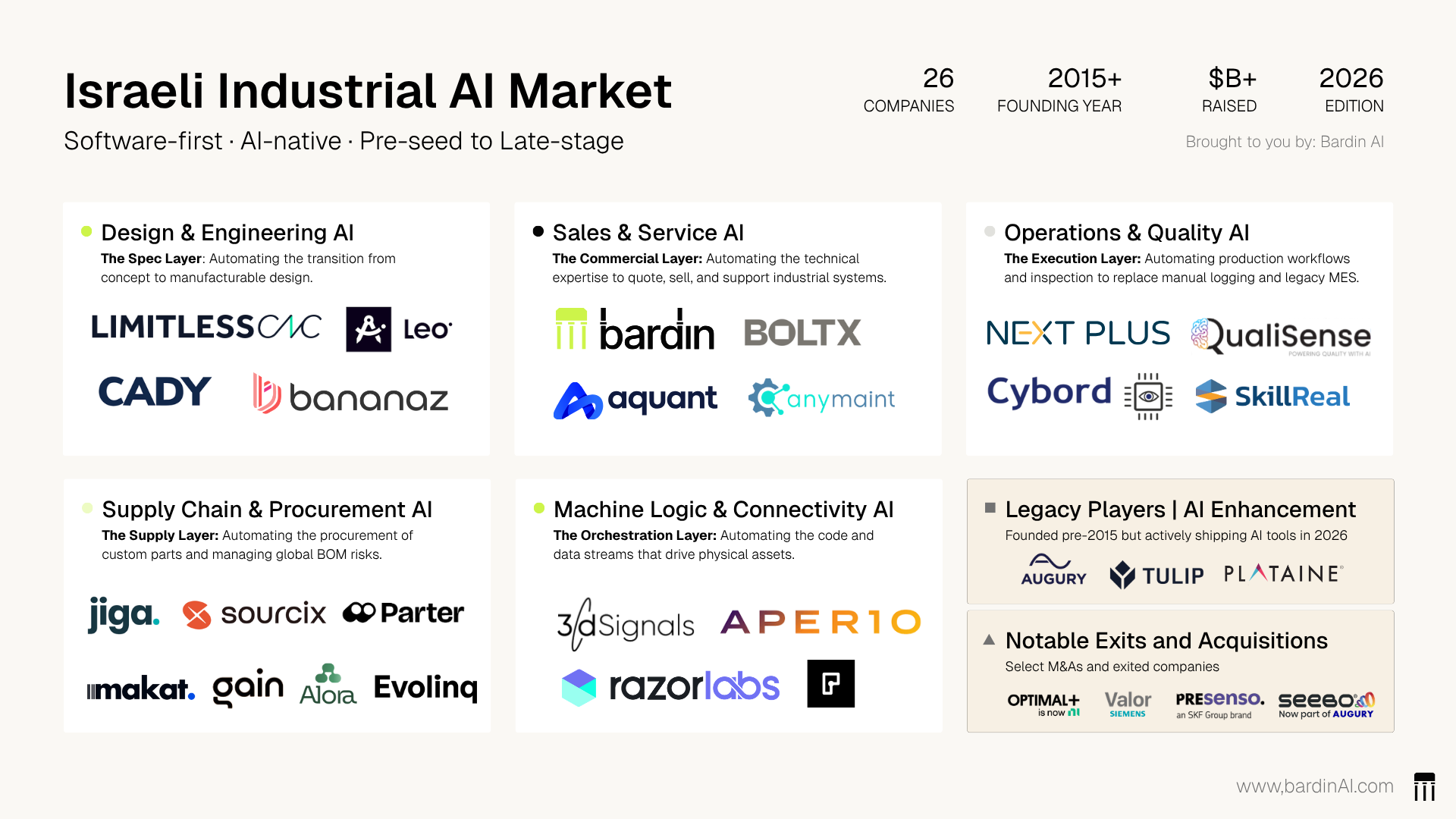
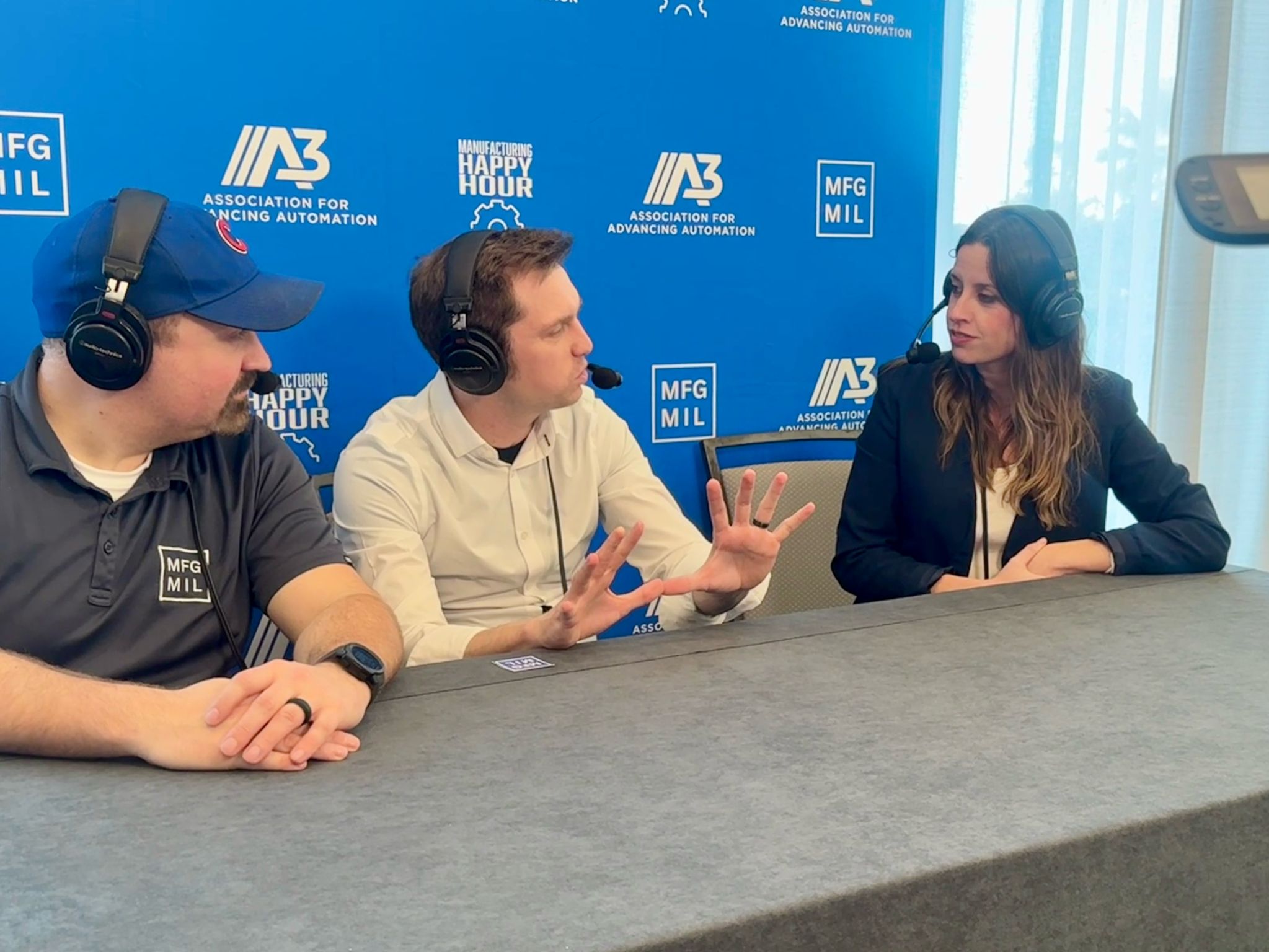

What if every industrial sales rep had an application engineer in their pocket? That’s the question I got to dig into on a recent episode of Manufacturing Happy Hour, one of the leading podcasts covering real-world trends and technology in modern manufacturing, hosted by industry veteran Chris Luecke alongside co-host Jake Hall, known across the industry as The Manufacturing Millennial.
We recorded live at the A3 (Association for Advancing Automation) Business Forum, and got into what’s really holding industrial AI back, what it takes to build something technical sales and application engineering teams will actually use, and why the companies that win won’t be the ones with the flashiest AI, they’ll be the ones that made it feel invisible.
The problem with industrial technical sales today
The reality of selling in industrial automation isn’t clean. A customer isn’t asking for “a sensor.” They’re asking you to solve a highly specific application: a Fanuc robot arm, a Siemens PLC, a dozen other constraints, right now, on the spot. And today that means hours of documentation rabbit holes, searches through millions of parametric options, and multiple rounds of back-and-forth before a proposal even lands. That loop is costing industrial sales teams deals, time, and credibility.
Bardin is built to close it. The simplest way to describe it: an application engineer in the pocket of every salesperson.
Brilliant but boring
Building AI that actually gets adopted in industrial markets requires something most AI companies get completely wrong: it has to feel like work people already know how to do.
At Bardin, the internal design rule is “brilliant but boring.” Not boring as in dull. Boring as in it feels like the workflow you already know.
The scoping form you’ve already filled out, but smarter. The configurator you’ve already used, but faster. The process you’ve done a hundred times, but without the exhausting back-and-forth. Just 10x, 20x, 50x more efficient.
If someone is used to filling out a robot application spec in Excel, the Bardin experience should feel close to that, with AI doing the heavy lifting behind it. If it feels foreign, too many steps, too esoteric, especially in focused vertical markets like industrial automation, people won’t use it. That’s not a technology problem. It’s a design problem.
Tribal knowledge doesn’t have to die with AI — it can compound
One of the biggest fears in manufacturing right now is that AI will hollow out decades of hard-won application engineering expertise. Teams will know the answers, but lose the understanding of why those answers are right.
The framing gets it backwards. The question a sales engineer asks, and the way they push back when an AI-generated answer isn’t quite right, is itself deeply valuable. The delta between what a customer asked and what the winning proposal contained is exactly where tribal knowledge lives.
Bardin is built to capture that delta. And because it’s built on a graph knowledge base — not a flat vector database — every answer can be traced back to its source. The nodes are your product and your customer’s application. The edges between them are where the knowledge sits. You don’t lose the expertise. You make it accessible to everyone on the team, and it compounds over time.
Where the market actually is
The AI hype cycle in industrial has matured faster than most expected. The “AI-powered everything” banners that dominated trade show floors a year and a half ago have given way to a much more practical conversation: how do we actually implement this, who owns it internally, and what does it cost in headcount to maintain?
That’s a healthy shift. It’s not that the excitement died, it moved from loud buzz into focused, practical energy.
The build-versus-buy tipping point is coming faster than most companies expect, especially in the mid-market. The vision engineers aren’t building motion systems. The motion engineers aren’t building robotics. The same logic will apply to AI for application engineering and sales. Companies that want to focus on what makes them money will stop maintaining AI infrastructure and start buying expertise built specifically for their domain.
Fay on Manufacturing Happy Hour with Chris Luecke and Jake Hall:
Full Transcript
Manufacturing Happy Hour · Chris Luecke & Jake Hall (The Manufacturing Millennial)
Chris [0:00]
Fay Goldstein, welcome to Manufacturing Happy Hour here at the A3 Business Forum.
Fay [0:05]
Thank you.
Chris [0:06]
We’re going to start off with the typical Manufacturing Happy Hour question — how do you describe Bardin as if you’re having a drink with someone?
Fay [0:17]
An application engineer in the pocket of every salesperson.
Chris [0:20]
AI agents for industrial technical sales. Can you paint a picture of what that looks like in practice?
Fay [0:41]
You are a technical sales rep getting a request from a customer — not just “I need this specific sensor or motor or drive.” What you’re actually getting is an application: “I’ve got this specific use case, in this specific industry, with this specific manufacturing plant, with a Fanuc robot arm and a Siemens PLC. What do we need to accomplish this niche application with one of your products?” And then these sales reps go down a rabbit hole — checking hundreds of pages of documentation, going through 600 million parametric options. The loop goes back and forth. Our goal is to tighten and shorten that complex process and make it more efficient.
Jake [1:47]
When you look at deploying automation, one of the biggest struggles is time to market, time to deployment — that’s why a lot of automation gets stuck. Is that one of the big benefits you’re seeing?
Fay [2:08]
I think it’s interesting. I just did a deep dive into those humanoids we all saw at CES. You have all these incredible opportunities, but people forget there’s still a human sitting behind the humanoid spending time figuring out: what does my customer actually need? What is the very specific niche use case? And then configuring the humanoid to make that happen. Until you speed up all of that process, you’re not optimizing that much. It’s not just getting to market — it’s getting to what your customer will actually find useful once it’s in their hands.
Chris [3:00]
Google was talking here about AI collaboration and “agency” — the idea that people can have more fulfillment in their work when they’re truly leveraging AI in a collaborative way that puts the human at the center. What are your thoughts on that?
Fay [3:52]
Google is an incredible company and the way they’re building their AI — the models and the ability for folks to build their own agents — is really powerful. But unless you’re building interfaces and workflows that folks are already used to, you’re going to lose a lot of people to the fear that “this is complicated.” So I have a slogan I tell myself internally: I want to build something brilliant but boring. I want my interfaces to feel close enough to existing workflows. If someone’s used to going through an Excel sheet to fill out robot application parameters, the experience should feel familiar — with AI working behind it. And that’s where agency comes: I can do what I’ve been doing, but now I’m 10, 20, 50 times faster, and it still feels like me.
Jake [5:51]
People are worried that AI will remove the tribal knowledge that’s existed in manufacturing for generations. We’ll know the answers but not why we got there. What would you say to that?
Fay [6:41]
This is where the brilliance of human-to-AI interaction comes into play. The questions people ask the AI — there’s so much brilliance in how they’re asking. And the way they push back when the AI gives an answer that isn’t quite right — that interaction is really valuable. The way we think about it at Bardin: you’ve got a customer RFQ, a historical troubleshooting question, and then the proposal that went back. The delta between what they asked and what we gave them — that’s where the tribal knowledge lives. If you build AI to understand that delta and learn from the questions being asked, you’re capturing the tribal knowledge and you can trace back to where it came from. And if you build on a graph knowledge base — not just a vector database — you’ve got nodes for your product and for your customer’s application, and the edges between those nodes are where the knowledge sits. You can traverse back and understand how you got to any answer.
Chris [8:28]
As someone building an AI company for the industrial space — focused on the sales niche right now — what is your overall perspective on the industry’s appetite for these solutions?
Fay [9:05]
There’s been a really big shift over the last year and a half. The first time I heard AI being broadly discussed in industrial was at Hannover Messe — massive posters, “AI-powered everything.” Then a year later at a more recent trade show, the tone had completely changed. It’s no longer “we’re moving to AI.” Now it’s: “How are we going to implement it? Because we know we’re getting there — now let’s actually talk about execution.” That’s actually a great transition. It moved from a loud buzz into a muted, practical energy. And as a founder, that’s what I’m dealing with right now: get to work, actually implement this, and make sure it doesn’t take a lot of people from a company just to make something do less work for them.
Chris [10:30]
Do you think this turns into a build-versus-buy question — where companies spend too much time trying to build their own versus finding a focused solution?
Fay [10:54]
It’s the classic build-versus-buy question. Some massive enterprises have the internal AI team to build, maintain, update prompts, and upgrade when models change — and honestly, they should be doing that. But “buy” doesn’t mean off-the-shelf generic software. It means buying expertise deeply focused on a specific use case. I think a lot of companies are really excited about building right now, and rightfully so. But in about a year, a lot of those folks will come back to companies that have built deep expertise in a specific space — application engineering, sales engineering — and say “okay, I actually want your solution.” When you look around the room at these associations, the vision engineers aren’t building motion. The motion engineers aren’t building robotics. Everyone’s staying in their lane. AI for industrial commerce is going to go the same way — especially for the mid-market, which wants to focus on what makes them money, not on maintaining AI infrastructure.
Chris [12:44]
Fay, I appreciate you taking us through the world of AI through your lens. Thanks, Fay.
Fay [12:57]
Thank you.
Bardin is an AI platform built for industrial automation sales and application engineering teams — putting the depth of an application engineer in the hands of every salesperson, at the point of sale. Built for OEMs, distributors, and systems integrators who need to scope, sell, and support complex technical solutions faster and smarter.
Learn more at: www.bardinAI.com
.png)