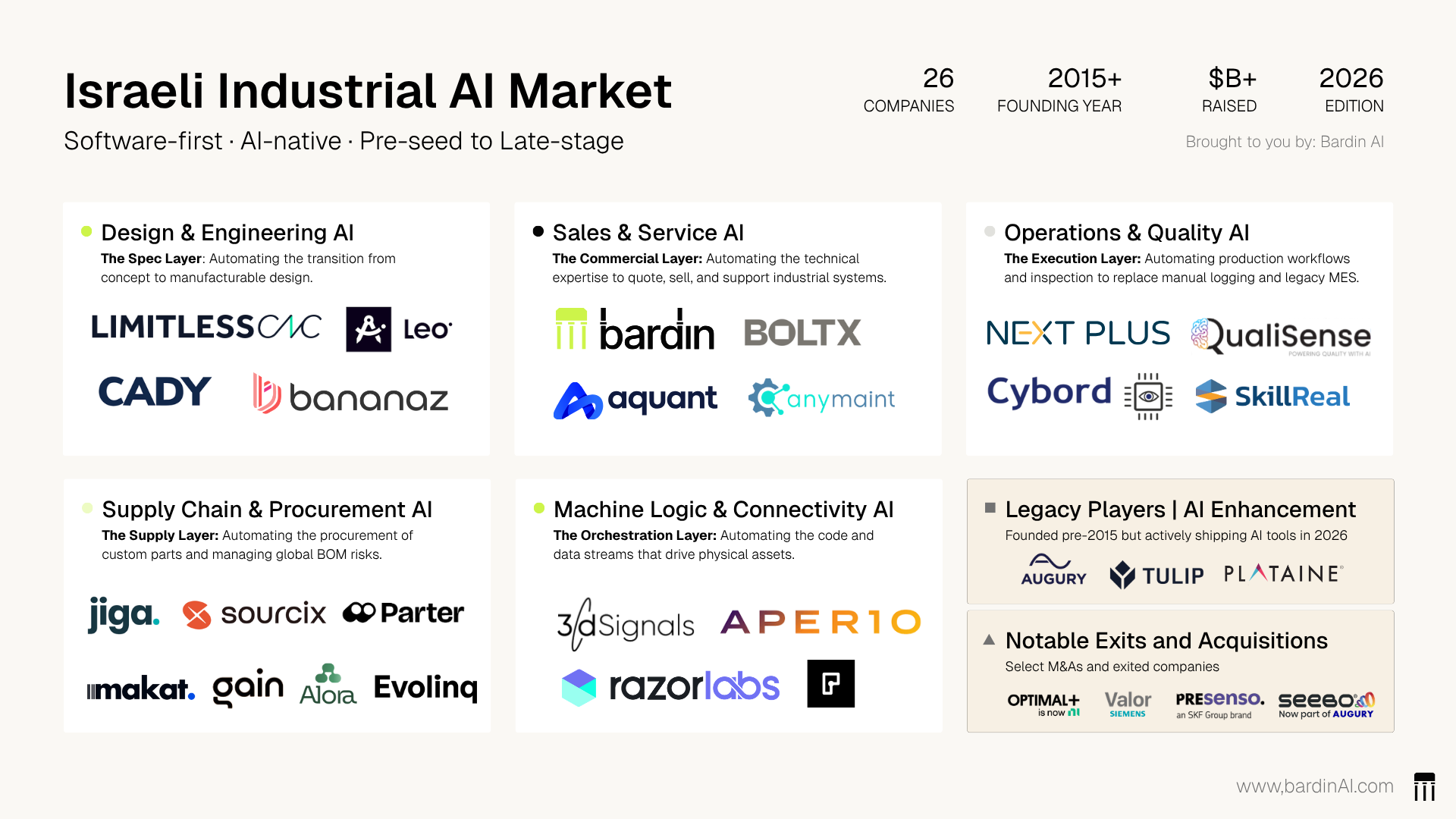
Building the Knowledge Infrastructure for Automation Deployment
We're building the infrastructure, agents, and tools that connect products, customers, and industrial applications into a single knowledge platform. So your team can scope faster, deploy with confidence, and stop reinventing solutions they've already solved.

Scaling engineering judgment for the teams that build, deploy, and support the physical world.
Our Values






Our Story
Bardin was founded by Fay and Amir, two builders shaped by manufacturing. Amir grew up on the floor of a family-run plant and later founded a technology company applying machine learning to complex enterprise challenges. Fay got her start in an automotive repair shop, then built a career in go-to-market strategy before working at an automotive telematics company where she saw firsthand the untapped potential of industrial data.
Both come from families rooted in manufacturing. Across their careers, they kept encountering the same problem: the engineering judgment required to scope, sell, and support complex industrial products lives in the minds of a few, and doesn't scale.
Bardin was created to change that. Named after John Bardeen, co-inventor of the transistor, Bardin is building the foundational knowledge layer for industrial automation deployment.
Supported By


Built on infrastructure the world's largest industrial companies already trust.
Your knowledge is your competitive advantage. We protect it like it is.
Bardin is built on enterprise-grade infrastructure from Google, Microsoft, and IBM, the same platforms that power the world's largest industrial companies. Every layer of our stack inherits their audited controls by design.
Google: SOC 2 Type II, ISO 27001, FedRAMP, ISO 27018
Microsoft: SOC 2 Type II, ISO 27001, FedRAMP
IBM: ISO 27001, SOC 2 Type II

Your data, your rules.
Your knowledge is stored in a private, isolated environment, never shared across customers, never used to train AI models, and never moved outside the United States without your explicit authorization. This isn't just a policy; it's a commitment.
Questions about security or compliance?
Our Security Policy, Data Processing Agreement, and No-Training Commitment are available to any prospective customer on request.
Frequently Asked Questions
Get the answers you need. Browse our FAQs for more information about Bardin.
What is Bardin, and what does it do for industrial teams?
Bardin is an AI platform with tools and agents built for applications engineering, technical sales, and support teams at OEMs, distributors, systems integrators, and RaaS companies. It's built for the full deployment cycle, scope through support. Teams use it to qualify opportunities, check product and application fit, and scope projects against real requirements. They use it to respond to customer requests, generate BOMs, and build technical proposals. Support teams use it to troubleshoot configuration issues and resolve tickets without escalating to senior engineers. Every answer is grounded in your product data, your application history, and your team's own captured engineering judgment, not generic internet knowledge.
What types of companies use Bardin?
Bardin serves automation component OEMs, robotics OEMs, robotics-as-a-service (RaaS) companies, systems integrators, and industrial distributors, teams that regularly answer product and application compatibility questions, scope custom automation and robotics solutions, or provide technical support for industrial equipment.
What problems does Bardin solve for industrial sales and engineering teams?
Three core problems: slow technical response times (customers waiting hours or days for an engineering answer), knowledge loss (expert judgment trapped in senior engineers' heads and lost when they retire), and scaling bottlenecks (growth constrained by how many expert engineers you have). Bardin addresses all three without replacing your people.
How is Bardin different from ChatGPT or Microsoft Copilot for industrial applications?
Copilot retrieves documents. ChatGPT generates from internet knowledge. Bardin reasons about industrial applications. When a customer asks whether a drive will work at 480V three-phase in a washdown environment with a 50-foot cable run, generic AI guesses. Bardin answers from your product data, your application history, and your engineers' captured judgment, with sources cited and reasoning traceable. It also captures the knowledge that never makes it into documentation in the first place.
How does Bardin compare to other options, like building internally or using a single-vendor AI tool?
Most alternatives fall short in a specific way. Generic AI tools have no knowledge of your specific products, past projects, or edge cases, and are prone to confidently wrong answers on proprietary technical content. Building an equivalent system internally typically takes 18-24 months and diverts engineers from revenue-generating work. Single-vendor OEM AI tools only cover that vendor's own ecosystem, which doesn't work if you sell or support multiple brands. Bardin is vendor-agnostic, purpose-built for industrial automation's application complexity, and grounded exclusively in your own validated knowledge, with every answer traceable to a real source.
What does "capturing tribal knowledge" mean in the context of industrial AI?
Every day, your team uses Bardin to solve real problems: finding the right product spec, answering a customer's technical question, scoping a project, troubleshooting a configuration issue. Every one of those interactions teaches the system how your experts think. When an engineer refines an answer, explains why a different approach works for a specific application, or documents that a particular valve doesn't perform in cleanroom environments because of a specific constraint, Bardin captures that reasoning. Over time, this transforms unwritten expertise into a structured, permanent knowledge asset. Your team's collective judgment survives employee turnover and grows stronger with every conversation.
Will Bardin use my data to train AI models?
Never. Your data is never used to train, fine-tune, benchmark, or improve any AI model, Bardin's or any third party's. Your proprietary engineering knowledge stays yours, always.
Does Bardin share my data with other customers?
No. Every customer's data lives in a completely isolated environment. Your documents, conversations, and extracted knowledge are never accessible to other customers or shared across the platform.
What security documentation can you provide for our procurement process?
We provide a full Security Policy, Data Processing Agreement, and No-Training Commitment, available to any prospective customer on request. For enterprise engagements we support security questionnaires and compliance reviews.
How long does it take to get value from Bardin?
You can see ROI immediately. You can start seeing value by simply adding your datasheets to Bardin, no integrations required. We then offer additional tiers for integrations and custom connections to deepen the impact. The deepest, most compounding value comes when Bardin is used daily and we can capture all the intelligence from those human-to-AI interactions. Most customers see measurable results within 30-60 days: 40x faster responses (from hours to minutes), 50% of engineering time reclaimed, and 30% faster sales cycles.
Why work with Bardin as a startup instead of an established vendor?
You get the best of both worlds. We combine startup speed and innovation with deep focus on industrial needs. We take your feedback seriously and iterate as partners, not as a vendor delivering a fixed product. Unlike massive consulting firms that charge premium rates for temporary projects, we're building a lasting platform, which means we're invested in your long-term success, not just billing hours. We're backed by experienced operators, investors, advisors, and industrial leaders who've built billion-dollar businesses, we have the expertise and network of a mature company with the agility of a startup.
What does your pricing look like?
We offer three tiers designed to grow with your team. Starter is for a small team proving value on a focused product line or project type. Growth is for mid-market teams running scope, deploy, and support workflows across full product lines, with integrations, managed ontology, and API access. Enterprise is for large deployments across multiple divisions or channels, with custom integrations, advanced security, and dedicated support. Every engagement starts with a pilot to prove value before full deployment. Contact us for details.
Our team is here to answer anything you're curious about, whether it's how Bardin works, what it could mean for your team, or just exploring if it's the right fit. Reach out anytime, and let's have a conversation about your specific needs and challenges.

.png)


.png)