.png)

Look, I’m not a Luddite. I love robots. I’m a founder in the industrial space for a reason.
But from what I saw from afar (and yes I am taking into consideration that my algorithm might be a tad rigged to show me more robots and machines than the average 30-something-year-old gal) the CES 2026 humanoid theater was... shall we say, “good for the gram, but eh for the grind.”
So, I didn’t actually make it to Vegas last week but I spent a (non-insignificant amount of time) watching the proverbial highlight reel from my desk while prepping to fly to another automation-related event next week. And after the tenth video of a chrome-plated humanoid doing some sort of flip or punch, I hit pause.
Don’t get me wrong.
The engineering inside and outside of these machines is nothing short of brilliant.
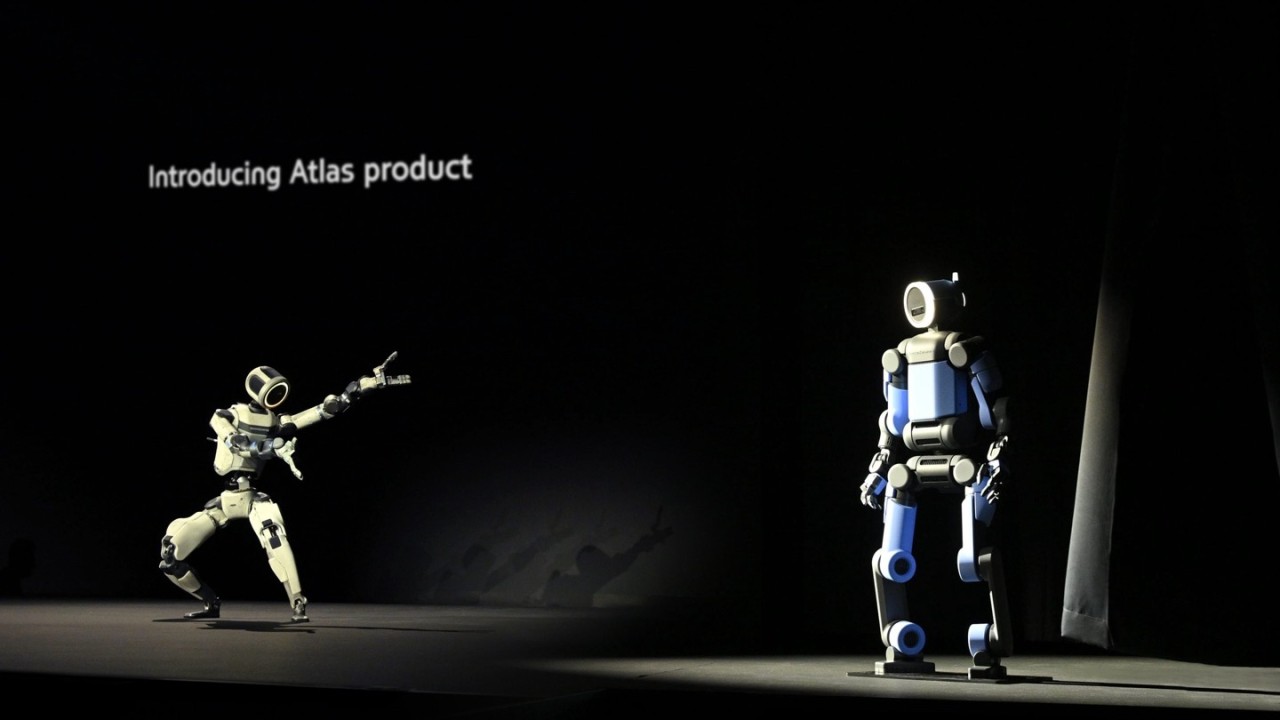
The torque density, the actuators, the models… it’s world-class. The engineering of the new and improved Boston Dynamics "Atlas" or the LG CLOiD is incredible (though Cloid’s shirt folding pace could use some work).
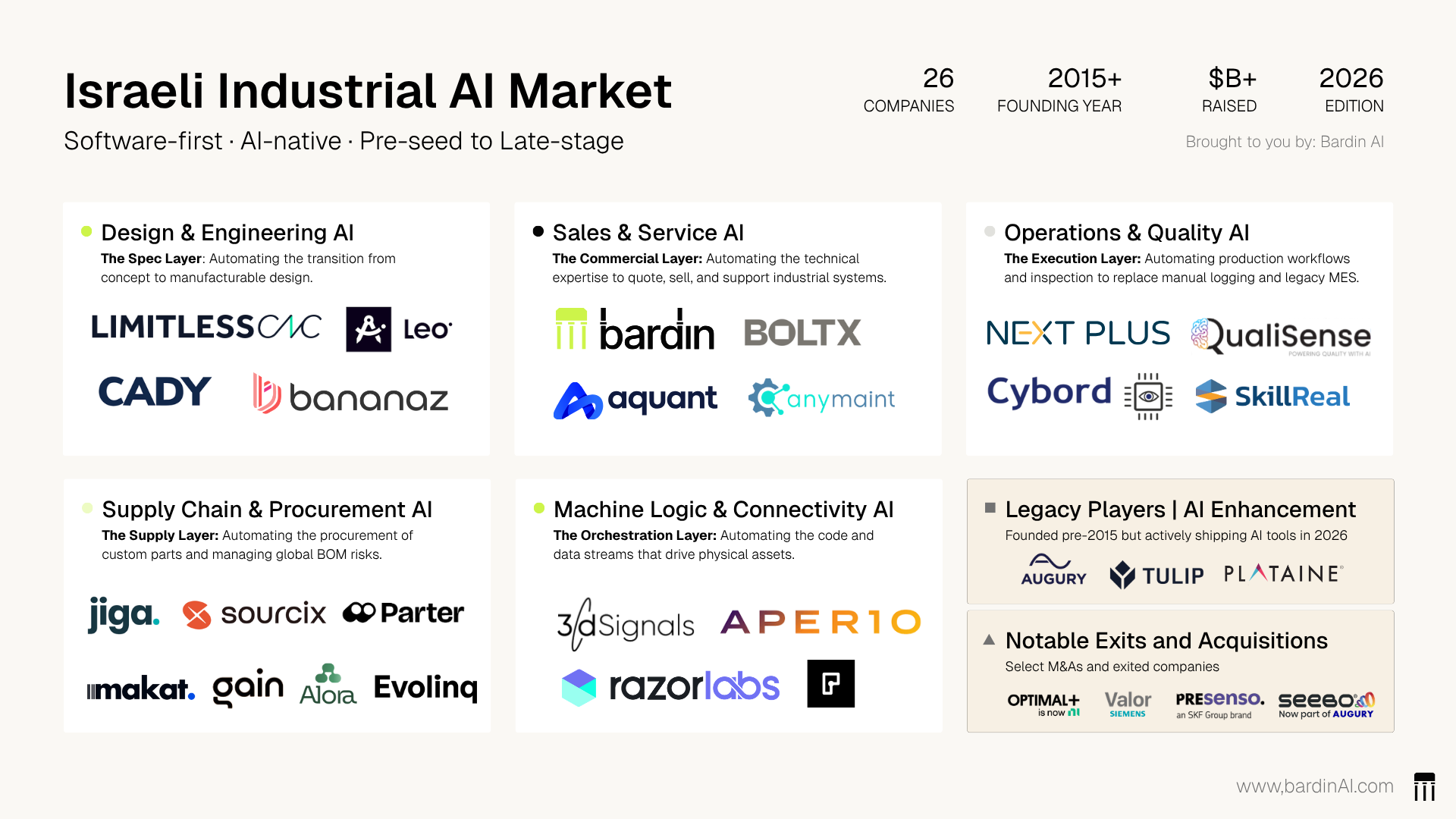
And tbh, this hype is great for us at Bardin, where we’ve been building industrial AI tools, to see The Economist confirming that the moment has finally arrived for manufacturing.
BUT the infrastructure supporting the actual application + implementation is a complete disaster. And so this “humanoid slob" that I feel compelled to complain about has nothing to do with Atlas (or his really important capabilities to help with tedious and heavy manual labor, since yes, its not just about “dancing” or shirt folding) is the chaotic, manual, and frankly prehistoric way we are still trying to sell, implement, and support the noids.
The Humanoid Implementation Gap in Industrial Robotics
We’ve reached a point where a robot’s internal logic can yes, handle a backflip, but the humans (period. no ‘noid’) responsible for selling, configuring, and maintaining it are still being forced into their own manual work.
The "hype" says we are entering an era of autonomous labor. But in the real world, if you want a robot to do anything more complex than a synchronized dance or deep-sea swim, you are immediately thrown into Excel Hell. And while the tech press swoons over bipedal movement, the real people in the trenches are stuck.
I recently spoke with a team at an awesome Robot-as-a-Service (RaaS) firm. Their packaging robots are mechanical poetry; systems that can speed up a line by 400% and theoretically pay for themselves in months.
But when it comes time to actually configure and apply that robot to a new customer’s specific needs?
They are manually building the application spec in an Excel sheet.
They lose every ounce of prior knowledge from previous projects. Every customer implementation feels like a "first time" because there is no unified intelligence layer. The applications and solutions team is a digital Sisyphus, pushing a $200k robotic boulder up a hill of unstructured data.
And obviously, we've spent thousands of hours with teams at companies selling motion control, sensors, drives, motors, and basically every component that makes a humanoid (and every industrial automation system) tick.
Even a mid-tier industrial humanoid can have tens of thousands of discrete components, each configurable in dozens, or hundreds, of ways depending on torque, load, speed, environmental tolerances, and safety requirements.
Multiply that by every possible combination across multiple subsystems, and you’re looking at millions of potential configurations. For engineers and integrators, every application is effectively a new puzzle; every new client a new mountain of spreadsheets, PDFs, and tribal knowledge.
PDF Archaeology and the 600-Million-Parameter Challenge in Automation Deployment
We all know that physical AI is a brutal, high-stakes math problem.
A robot dancing at a trade show is a controlled parlor trick.
A robot rolling into a subterranean mine or a high-heat manufacturing cell is a nightmare of variables.
To make that shift, an industrial applications engineer has to balance a terrifyingly complex ecosystem of interrelated encoders, drives, and sensors. They're not simply "picking a robot"; they are navigating what feels like 600 million parameters of "if/then" configurations:
- Will this high-torque drive survive a 110-degree warehouse?
- Which encoder won't fail under this specific vibration frequency?
- Is the legacy PLC even capable of talking to this new "AI" brain?
In fact, that 600m number wasn’t just random, a senior exec at a German motor company said that to build their configurator for integrated drives (specially designed drives for robot and AGV manufacturers), they needed to build a roughly 600 million parameter framework that took them 4-5 years, and needs to constantly be manually updated.
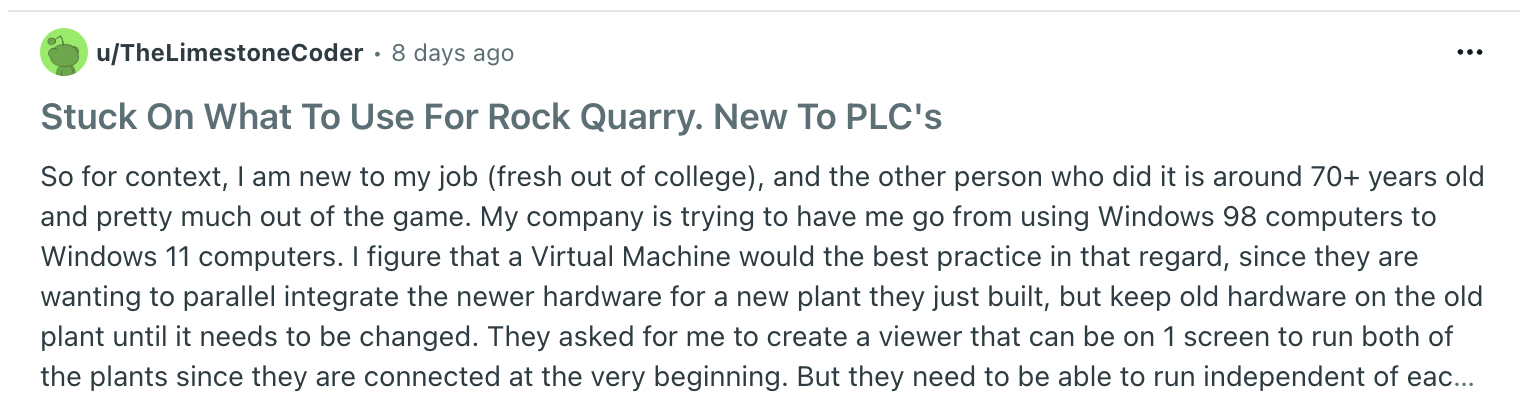
And now, with every use case being so so so very specific, aka, applications from the customer-side are so very nuanced from the hardware and software perspective, the answers to those nuanced questions aren't really in those configurators. They’re buried in 500-page PDFs, hidden in legacy documentation from OEMs that haven't updated their UI since the Clinton administration, or past successful or failed implementations in a most-similar, but maybe not-so-similar previous project, or the most fun to see: being answered by strangers on Reddit threads because the original PLC manual is lost to history or the guy that knows it is 70 years old (yes, this was literally from 8 days ago).
The Complexity Wall vs. The Silver Tsunami Knowledge Loss
The big issue we’re seeing (and not just reading in reports) is that the hardware and software complexity in industrial automation is scaling vertically, while our engineering workforce is shrinking.
With the "Silver Tsunami" (aka, the nice way of saying “people get old and rightfully retire”) we’re losing our most experienced industrial engineers, and they are taking their "tribal knowledge" with them. A whopping 52.4% of the industrial workforce is expected to retire or leave within the next 5 years. We are leaving the most advanced systems in human history in the hands of a dwindling number of engineers who have been given very few modern tools to manage the chaos.
The sad thing is, like the 10 years of “self-driving car hell” (where folks building this incredible tech was waiting for regulation and actual on-the-real-road implementation to catch up...and where at this 2026 CES, Nvidia's Jensen Huang had a pretty cool announcement re: it), the automation and robotics hype will stay hype not just if an algorithm can’t tell a robot when to stop dancing, but if the engineers building and selling them are still forced to dive down a rabbit hole just to get a motor to spin.
The Circus vs. The Foundation in Industrial AI
The industry is obsessed with the end-effector (those fancy robots hands) but mostly ignores the middleware (the mind of the engineer). At Bardin, we don't care about the robot’s "soul." We care about the application engineer’s sanity.
There’s lots to do to make sure that the "humanoid slob" doesn’t end up sitting on your factory floor waiting for someone to make it useful; beautiful, but broken.
And so while the much of the industry is chasing shiny bots, we’re building the tools for the person holding the wrench (or the PLC code ;).
I like to call it “boring, but brilliant”.
Bardin turns decades of expertise into an always-on technical sales and industrial application engineer.
Bardin's AI tools and agents scale engineering judgment, helping industrial sales and application engineering teams scope, sell, and support complex industrial solutions today while building the knowledge infrastructure to power the future of industrial commerce.
.png)